
Analysis
What changes for crypto in Brazil on 30 October 2026
The filing deadline, the rules for filers and non-filers, the 6 November ban on banks and what users should check. With the text of the rules.
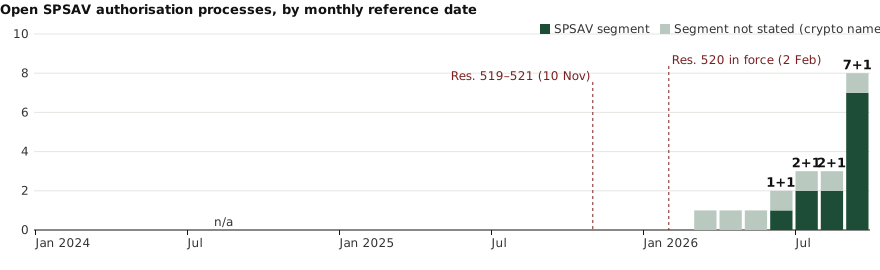
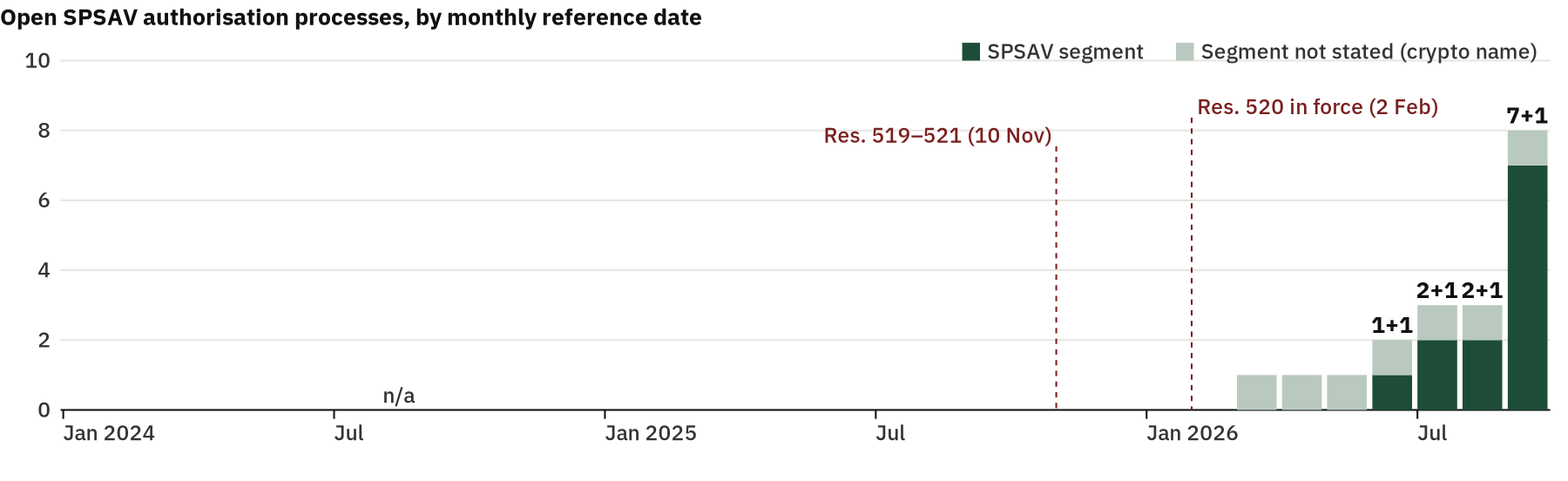
On 30 October 2026 the deadline expires for crypto firms already operating in Brazil to apply to the Central Bank for authorisation. A week later, on 6 November, banks and payment institutions are barred from enabling operations with unauthorised providers. At the latest reference date in BCB open data (30/09/2026), 7 SPSAV authorisation processes were open and no company was listed as authorised.
Who must apply
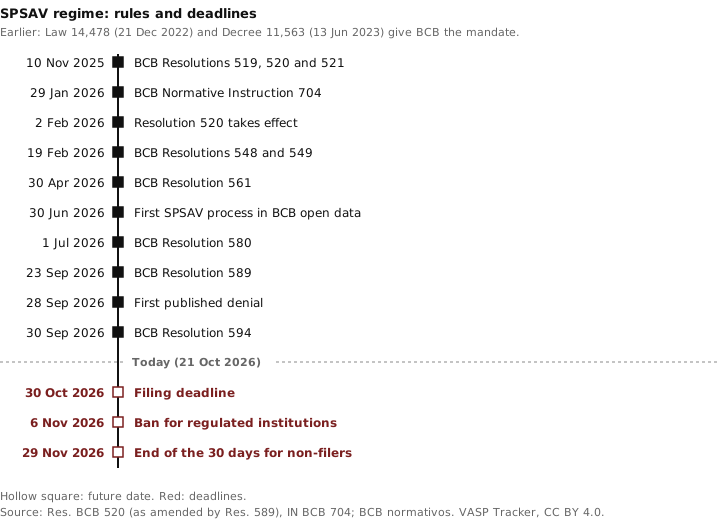
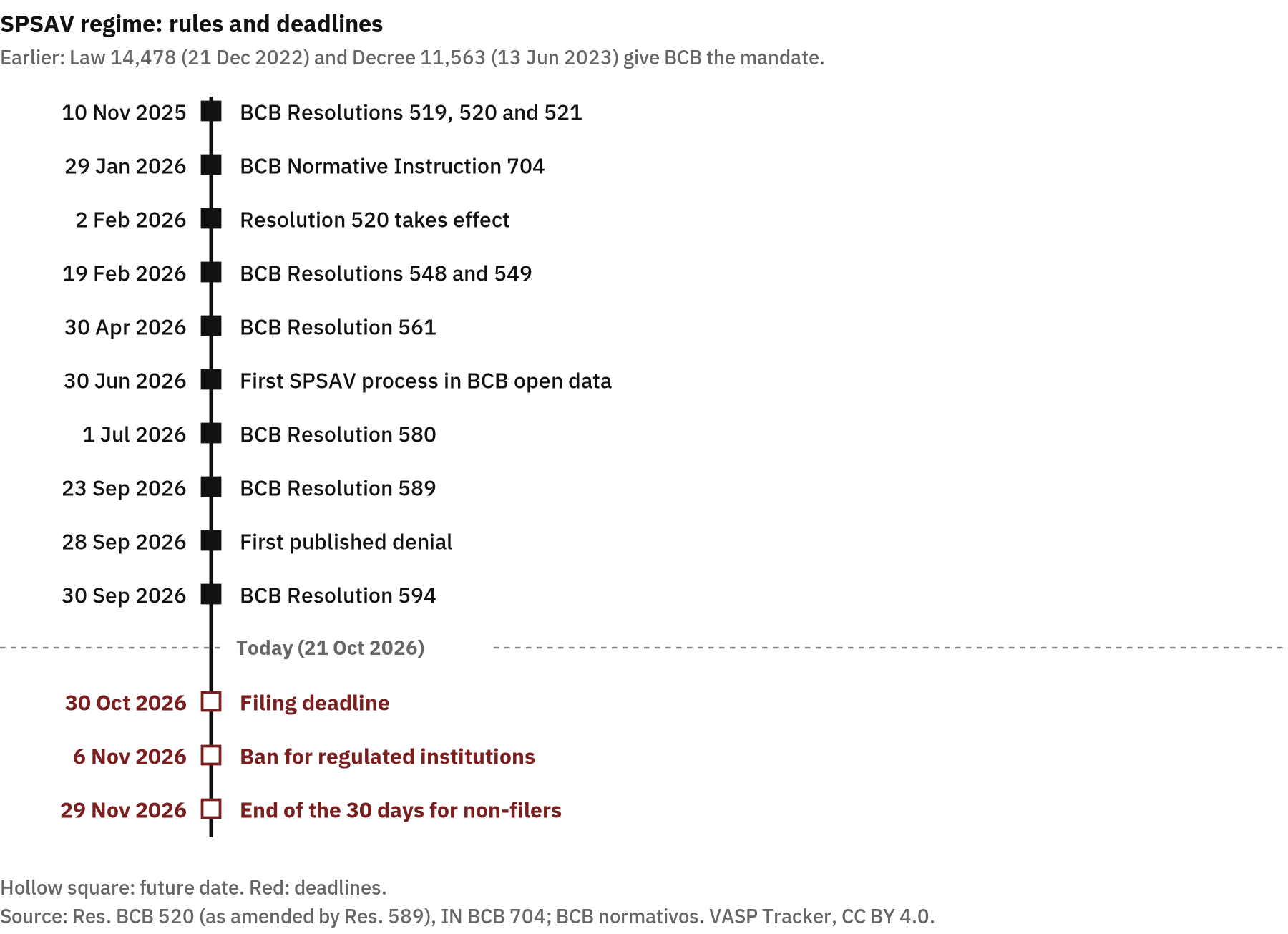
Law 14,478/2022 requires prior authorisation for virtual-asset service providers (art. 2), and Decree 11,563/2023 gave the Central Bank the power to grant it. BCB Resolution 520, in force since 2 Feb 2026, created three types of virtual-asset service company (SPSAV): intermediary, custodian and broker (art. 4).
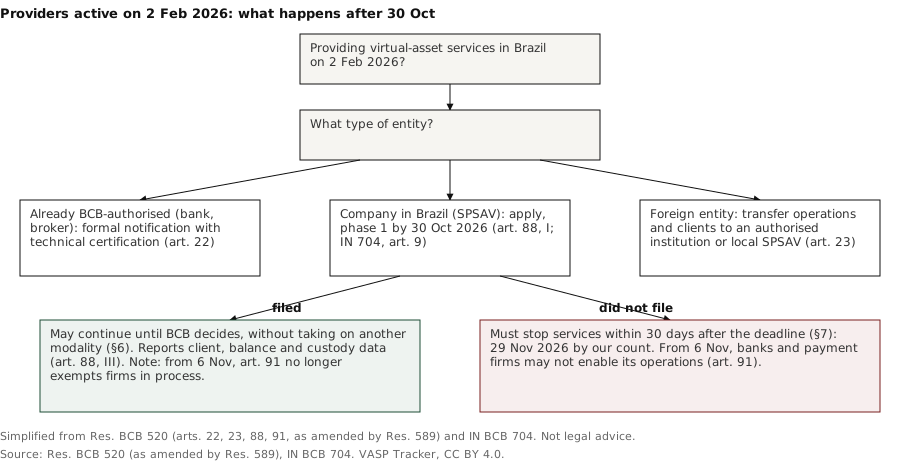
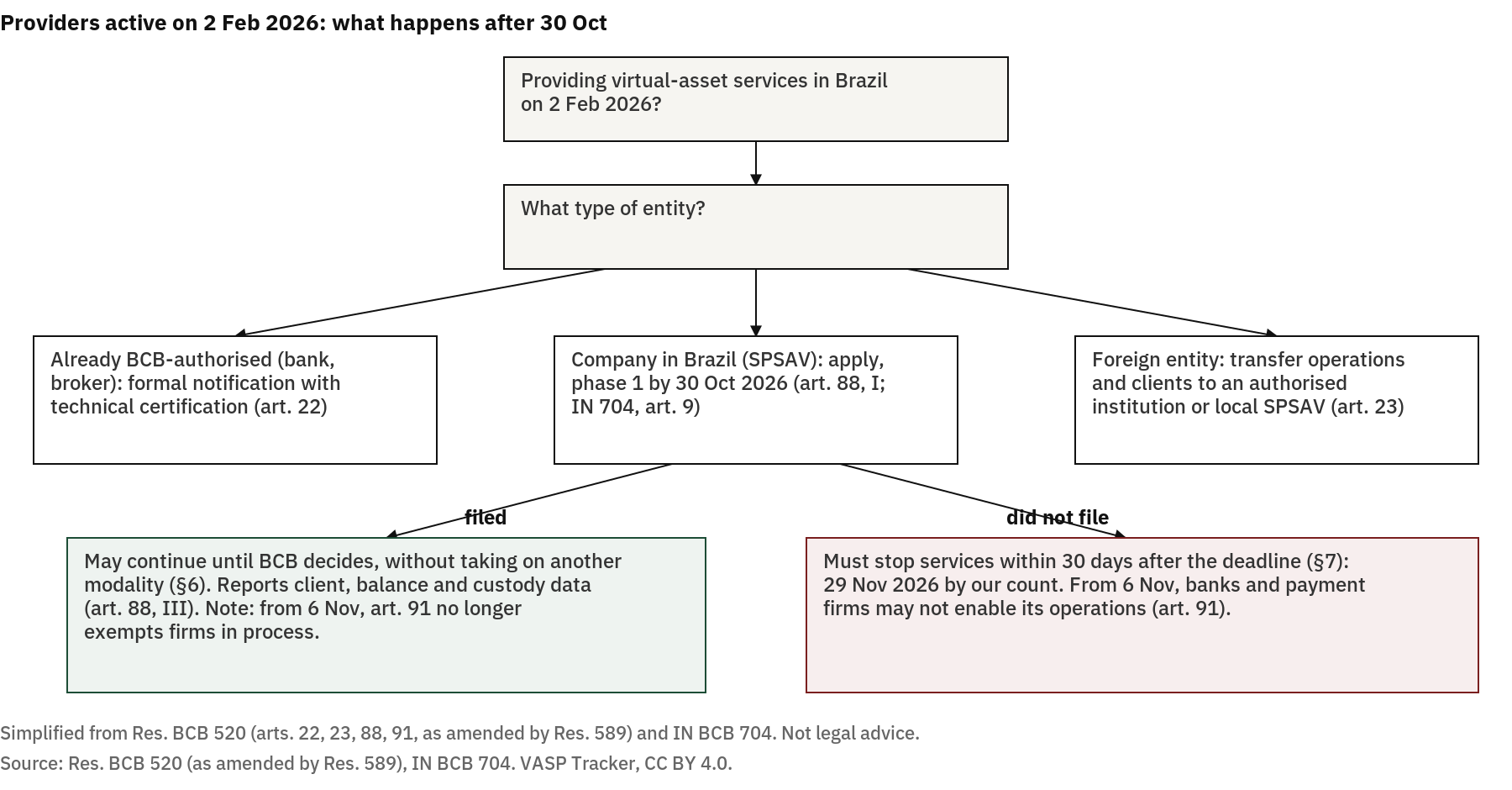
Firms already providing these services on 2 Feb 2026 have 270 days to apply (art. 88, I). BCB Normative Instruction 704 sets the date: phase 1 of the application must be filed “by 30 October 2026” (art. 9), with a standard request and declarations. Banks and other already-authorised institutions instead file a formal notification with an independent technical certification (Res. 520, art. 22). Foreign entities must transfer operations and clients to an authorised institution or an SPSAV in Brazil (art. 23).
Firms that filed on time
They may keep providing services “until the conclusion of their authorisation process”, without taking on another modality in the meantime (Res. 520, art. 88, §6). From filing, they must report client data to the financial-system client register, daily balances and custody, and monthly proof of reserves (art. 88, III). The adaptation period ends when BCB rules on phase 1 (§1).
Firms that did not file
They must “cease providing virtual-asset services within thirty days after the end of the deadline” (art. 88, §7). By VASP Tracker's count, 30 days after 30 Oct 2026 is 29 Nov 2026; the rule does not state that date explicitly.
6 November: what Resolution 589 prohibits, and for whom
The rule binds regulated institutions, not the crypto firms themselves. BCB Resolution 589 of 23 Sep 2026 rewrote art. 91 of Res. 520 (Portuguese original):
“É vedado, a partir de 6 de novembro de 2026, às instituições financeiras, às instituições de pagamento e às demais instituições autorizadas a funcionar pelo Banco Central do Brasil realizar ou viabilizar operações no mercado de ativos virtuais que tenham como contrapartes instituições ou entidades que prestem serviços de ativos virtuais e não estejam autorizadas a funcionar no país por essa Autarquia, exceto nas formas expressamente autorizadas nesta Resolução.”
Res. BCB 520, art. 91, caput, com redação dada pela Res. BCB 589 (em vigor desde 01/10/2026).
In translation: from 6 November 2026, financial institutions, payment institutions and other BCB-authorised institutions may not carry out or enable virtual-asset market operations whose counterparties are virtual-asset service providers “not authorised to operate in the country” by BCB, “except in the forms expressly authorised in this Resolution”. The original text started on 30 Oct 2026 and excluded providers “authorised or in the authorisation process”: “… que tenham como contrapartes entidades que prestem serviços de ativos virtuais e não estejam autorizadas ou em processo de autorização a funcionar no país …”. The new text drops “or in the authorisation process”. Read literally, from 6 November the only permitted counterparty is an authorised provider, subject to the “expressly authorised” exception.
The scope is broad. The sole paragraph, unchanged, extends the ban to trading, intermediation and custody of virtual assets, foreign-exchange operations, opening and maintaining payment accounts and making payment transactions, when done to enable such operations:
“A vedação de que trata este artigo alcança negociações, intermediações e custódia de ativos virtuais, realização e intermediação de operações de câmbio, abertura e manutenção de contas de pagamento e realização de transações de pagamento, entre outros atos e serviços, quando praticados para viabilizar as operações mencionadas no caput.”
Res. BCB 520, art. 91, parágrafo único (não alterado).
What remains open: whether the continuity granted to timely filers (art. 88, §6) counts as one of the “expressly authorised forms”. The rule does not say, and as of 20 Oct 2026 we found no BCB statement clarifying it. Because no SPSAV was listed as authorised by that date, the answer decides whether banks may keep serving firms that did file.
What the data shows
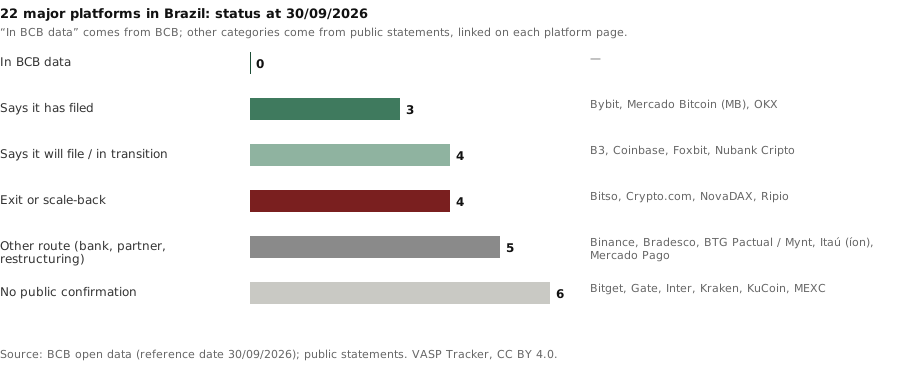
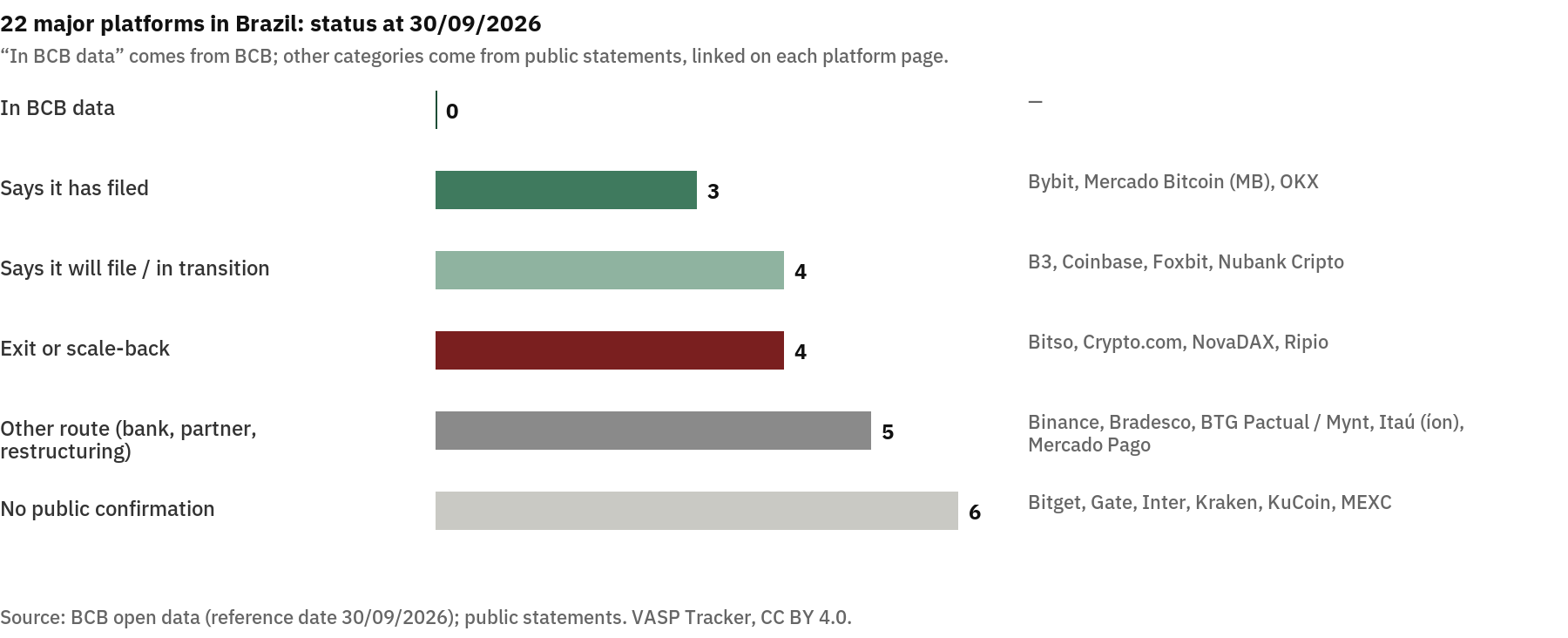
None of the 22 major platforms we track appears in the 30/09/2026 process dataset. 3 say they have filed since, or without a public filing date (Bybit, Mercado Bitcoin (MB), OKX); 4 say they will apply or operate under the transition regime (B3, Coinbase, Foxbit, Nubank Cripto); 4 announced an exit or scale-back (Bitso, Crypto.com, NovaDAX, Ripio); 6 have not confirmed publicly (Bitget, Gate, Inter, Kraken, KuCoin, MEXC). Absence from the dataset does not imply wrongdoing: the data is monthly and predates the deadline.
What it means for users with balances on a platform
The rule sets no single procedure for returning client assets: each exiting firm sets its own deadlines. Recorded examples: NovaDAX allows crypto withdrawals until 30 Oct; Bity announced migration and asset conversion on 27 Nov; Lemon closed accounts on 16 Oct (sources on each platform page). Brazil's Consumer Protection Code applies to virtual-asset market operations (Law 14,478, art. 13).
What to check: (1) whether the platform appears in the VASP Tracker table or the BCB dataset; (2) the company's own notice on its application or exit; (3) announced withdrawal or migration deadlines; (4) which Brazilian entity (CNPJ) the company says it operates through.
For information only; not legal or financial advice.
Sources
- Lei 14.478/2022 www.planalto.gov.br
- Decreto 11.563/2023 www.planalto.gov.br
- Resolução BCB 520/2025 www.bcb.gov.br
- Resolução BCB 589/2026 www.bcb.gov.br
- Instrução Normativa BCB 704/2026 www.bcb.gov.br
- BCB · Processos de autorização (dados abertos) dadosabertos.bcb.gov.br